Why ANC 2E Redistricting is a Win for the Whole Community

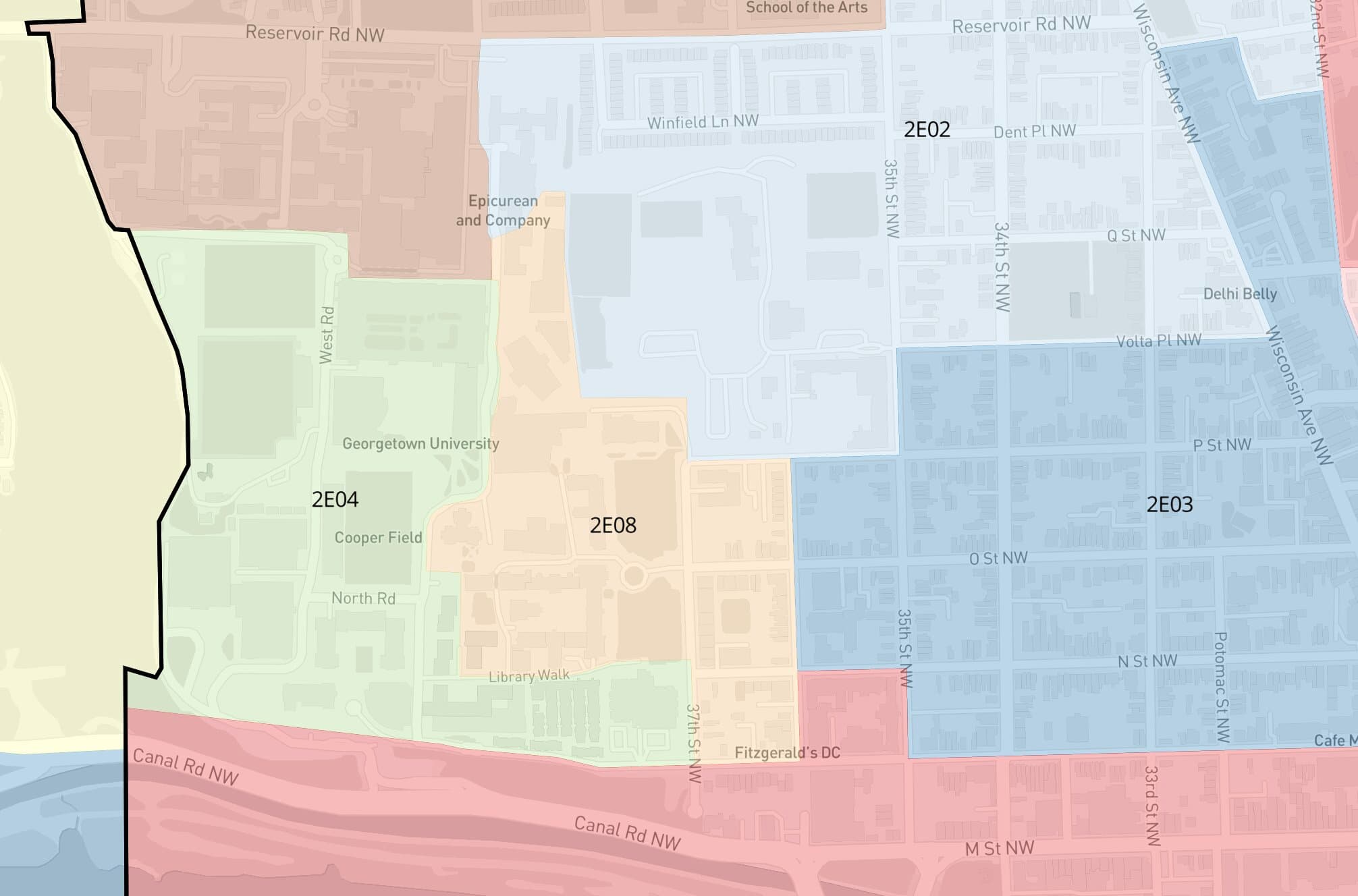
Every ten years, the city redraws the lines that decide who speaks for us on the issues closest to home. Most people will never think about it. That's a shame, because few bodies touch student life as directly as ANC 2E. Its commissioners weigh in on the Campus Plan, noise and trash enforcement, parking rules, liquor licenses, and the zoning and historic-preservation decisions that shape Georgetown. D.C. law requires the city to give an ANC's written advice "great weight," so who sits at that table matters.
Georgetown's student dorms are currently divided among five different single-member districts, yet only two of those districts are student-only. That means thousands of students live in districts where they're a fragment of the electorate, with a commissioner who answers mostly to someone else. It's a strange way to draw a map around one of the most concentrated populations in the neighborhood.
Students have historically made up roughly 45 percent of ANC 2E's population. Two seats on an eight-member commission is 25 percent. Three student districts would bring that to 37.5 percent, and four would bring it to 50, which is much closer to the share of the community students actually are.
Spreading dorms across five districts intentionally dilutes student voices. A student bloc that could decide a race in one district instead becomes a minority in several, too small to swing any of them and too scattered to organize around shared concerns.
Consolidating those dorms into three or four compact districts is also the cleaner map. D.C.'s districting guidance calls for roughly equal populations of about 2,000 per district, and a few thousand students living in close quarters fill that quota almost by themselves. Drawing lines around where people actually live is exactly what districting is supposed to do, and it beats cutting a single residence hall into pieces.
Each of those districts would also be a real constituency instead of an afterthought. Commissioners would have to answer for housing costs, late-night safety, the Campus Plan, and noise enforcement to the people most affected by them. A commissioner elected by students has every reason to show up at the ANC table prepared and to bring back what neighbors are saying.
Some long-time residents will say that students are temporary and that permanent residents have more at stake. It's a fair concern, and worth taking seriously (neighbors who pay property taxes and stay for decades do bring institutional memory that the ANC needs). But D.C.'s districting rules count residents, not tenure or voting history, and for good reason. Students vote, rent, work, and live in these neighborhoods nine months a year. Their absence from the table has never made friction with neighbors go away. It has only meant that disputes get settled without them, usually badly.
If anything, more student representation should lower the temperature. When students have commissioners of their own, they have a legitimate channel to raise concerns before they turn into conflicts. Commissioners who depend on student votes have a reason to explain to their constituents why the rules on noise and trash exist. Commissioners elected by longtime residents have a reason to hear how housing costs and restrictive policies push students into the same blocks. Neither side can ignore the other once both have seats.
Redistricting is unglamorous work, and no map will please everyone. But a map that counts people equally and draws districts around communities is the right starting point. It gives students a real voice, gives neighbors a real counterpart, and gives the whole ANC a better shot at solving problems together instead of litigating them across a podium. That's a win for everyone who calls Georgetown home.